https://www.cloudwards.net/binance-review/
Binance is one of the largest names in the cryptocurrency market and attracts both experienced traders and people opening an exchange account for the first time. Its size, broad selection of assets and unusually deep product catalog make it difficult to ignore. At the same time, the company’s regulatory history and some awkward parts of the cash-out process mean it deserves a closer look before you deposit money.
This Binance review covers the practical points that matter most: how the platform differs from Binance.US, what products are available, how the fee system works, what signup and trading feel like, and what happens when you want to move your money back out. The goal is not to declare Binance universally good or bad, but to show where it performs well and where caution is justified.
Key Takeaways: Binance
- Binance ranks among the world’s largest cryptocurrency trading platforms, although its scale has also drawn sustained attention from regulators.
- Its product lineup is exceptionally broad, extending well beyond ordinary spot trading to derivatives, loans, staking, cards and other advanced services.
- There are effectively two versions of the platform: Binance for most international markets and Binance.US for American customers. The U.S. version is more limited and generally charges higher fees.
- The website is reasonably easy to learn, and its tooltips and introductory prompts encourage new users to explore the interface.
On balance, Binance is approachable and does a better job than many competitors of publishing its fee structure openly. Those fees are not always the cheapest available, but they are easier to investigate than the pricing on platforms that bury costs in spreads or vague terms. The larger concern is Binance’s history with regulators. For that reason, it is sensible to avoid leaving more money on the exchange than you need for active trading.
Binance Review: Pros and Cons
Pros
- Relatively easy to use once the layout becomes familiar
- Fee schedules are published and reasonably transparent
- One of the widest selections of products and tradable assets
Cons
- A complicated and sometimes troubling regulatory history
- Selling crypto and moving funds back to a bank can be inconvenient
Binance Overview and Background
Like many major cryptocurrency exchanges, Binance has a history marked by rapid growth, frequent relocation and repeated clashes with regulators. The company was founded in China in July 2017. Only two months later, after China prohibited cryptocurrency trading, Binance moved its operations outside the country. Since then, it has often appeared to operate across many jurisdictions without being firmly rooted in any one of them.
The exchange briefly established a presence in Japan and later associated itself with Malta, although Malta’s financial authority publicly disputed the idea that Binance was formally based there. Reports from the Financial Times have since placed the company’s headquarters in the Cayman Islands. Meanwhile, founder and former CEO Changpeng Zhao — almost universally known as “CZ” among Binance users — made Dubai his home.

Despite its relatively short existence, Binance quickly grew into one of the largest cryptocurrency exchanges in the world. Its total market presence has dwarfed most competitors, placing it in the same broad conversation as Coinbase and, before its collapse, FTX. Size alone does not make an exchange safer, but it does help explain why Binance offers so much liquidity and such a large product catalog.
The company has also appeared in headlines for less flattering reasons. During its time associated with Malta, reports alleged that Binance processed transactions connected to money laundering worth hundreds of millions of dollars. In December 2022, news emerged that U.S. prosecutors were considering charges against CZ and other Binance executives over possible legal violations.
Another controversy followed in January 2023, when reports indicated that Binance had combined some customer assets with company funds. Binance described the situation as an operational mistake rather than deliberate misuse. Even so, mixing corporate and customer assets inevitably reminded observers of the practices that helped bring down FTX, and it raised fresh questions about how carefully the exchange handled funds behind the scenes.
Binance vs Binance.US
Whatever conclusion you reach about the allegations surrounding Binance, it is clear that a number of governments have been uncomfortable with the company’s compliance record. The most consequential restriction arrived in 2019, when the United States blocked the main Binance platform for failing to meet federal regulatory requirements. Binance responded by launching a separate exchange designed specifically for American customers.
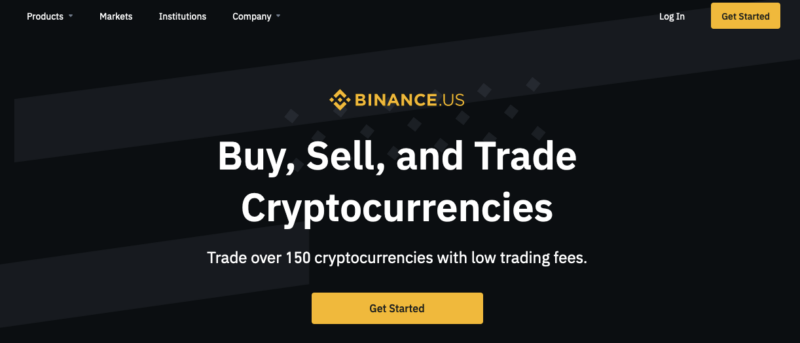
That U.S. platform is called Binance.US, and it is the only version intended for customers in the United States. Even Binance.US has not been available everywhere. At the time covered by the original review, residents of Hawaii, Texas, Vermont and New York could not use it. Binance.US also differs from the international exchange in several important ways, including its asset selection, product availability and fee structure.
The regulatory picture is not limited to the United States. The United Kingdom has also imposed restrictions on Binance. Users could still access parts of the service for cryptocurrency trading at the time of the review, including through a U.K. IP address, but the legal status of particular features may differ from one period to another.
Binance has also faced disputes or restrictions in countries including the Netherlands, Canada and Germany. Anyone thinking about opening an account should check the rules in their own jurisdiction first. A platform may allow you to create an account while limiting deposits, derivatives, withdrawals or other features based on local law.
The 2023 SEC Lawsuit
In June 2023, the U.S. Securities and Exchange Commission sued Binance, Coinbase and several other major cryptocurrency companies. The central allegation was that the defendants had offered securities without completing the registrations required by U.S. law.
The dispute reaches beyond a single exchange. Cryptocurrency regulation has long turned on whether digital assets should be treated primarily as commodities — tradable items whose prices are determined by the market — or as securities, which are financial instruments subject to more extensive oversight. The SEC has pushed for a broader securities classification, while much of the crypto industry prefers the lighter regulatory framework generally associated with commodities.
It was too early in the original review to know the full consequences of the Binance and Coinbase cases, but the stakes were clearly high. If the exchanges prevailed, the loosely regulated culture of the cryptocurrency industry could gain stronger legal footing. If the SEC prevailed, many practices that had become normal in the market could face strict new limits.
The immediate market impact was already visible. After the lawsuits became public, Binance.US reportedly lost roughly 76% of its liquidity. That sharp decline made the U.S. platform a questionable place to store assets while the legal situation remained unsettled. Litigation of this scale can take years, so uncertainty may continue well beyond the first headlines.
Binance Features Overview

| Feature | Availability |
|---|---|
| Centralized exchange | Yes |
| Cryptocurrency trading | Yes |
| NFT trading | Yes |
| Futures trading | Yes |
| Options trading | Yes |
| Other derivatives | Yes |
| Crypto staking | Yes |
| Debit card | Yes |
| Direct withdrawal support | Not consistently available |
| Published fee schedules | Yes |
| Web and desktop access | Yes |
| Mobile app | Yes |
Available Products
Binance lists hundreds of digital assets. The catalog stretches from familiar cryptocurrencies such as Bitcoin and Ether to stablecoins, gaming tokens, NFTs and many smaller or more specialized products. The company has also offered a Binance Visa card that lets users load cryptocurrency onto a payment card for everyday spending.
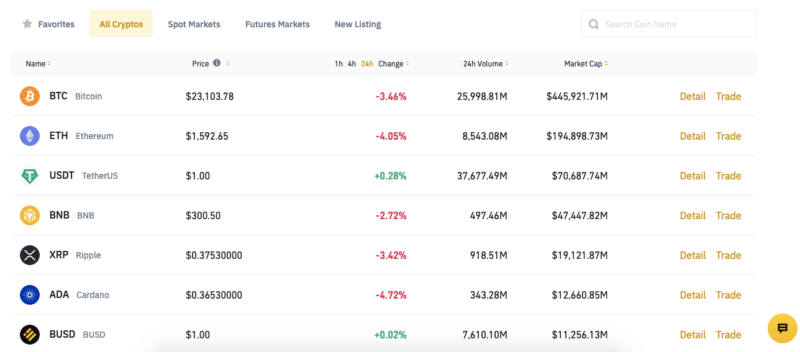
International users can review the full list on the main Binance website, while American customers need to check the separate Binance.US catalog. At the time of the original article, the three leading assets in Binance’s regular spot market were:
- Bitcoin (BTC)
- Ether (ETH)
- Binance Coin (BNB)
Buying and selling individual coins is only the beginning of the platform’s product range. Binance also provides several types of crypto derivatives. Futures allow traders to speculate on the price of an asset at a later date. Options grant the right to buy or sell at a predetermined price within a specified period. Leveraged tokens magnify the movement of an underlying asset, increasing potential gains while also amplifying losses.
Binance also offers crypto-backed loans. In practice, users borrow funds while Binance serves as the intermediary. Interest is charged, and the borrowed money is commonly used for margin trading. That allows traders to control a larger position than their own balance would normally support. The possible upside is greater, but so is the risk of losing money quickly or being liquidated when the market moves in the wrong direction.
Staking on Binance
Staking is another major part of Binance’s product offering. By committing eligible cryptocurrency to a blockchain network, users help support that network’s operation and may receive rewards in return. Exchanges often present staking as the crypto equivalent of a high-yield savings product, because it can generate a return without the user actively trading.
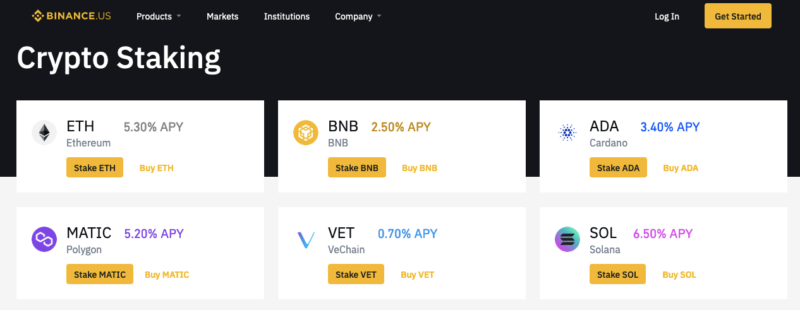
The comparison with a savings account should not be taken too literally. Staked cryptocurrency remains exposed to price volatility. A reward paid in a token that loses half its market value may leave the investor worse off despite the advertised yield. Some staking arrangements also require funds to remain locked for a fixed period. If prices fall rapidly, users may be unable to withdraw or sell until that lockup ends.
Trading Fees and Rates
Binance’s fee system is complicated, but the platform at least publishes the details. The international exchange and Binance.US use broadly similar tiered models, although the actual percentages differ and American customers generally face higher costs.
Binance maintains separate fee schedules for worldwide users and U.S.-based customers. Those pages can look intimidating at first because they include multiple tiers, maker and taker rates, rolling trading volume and BNB balance requirements.
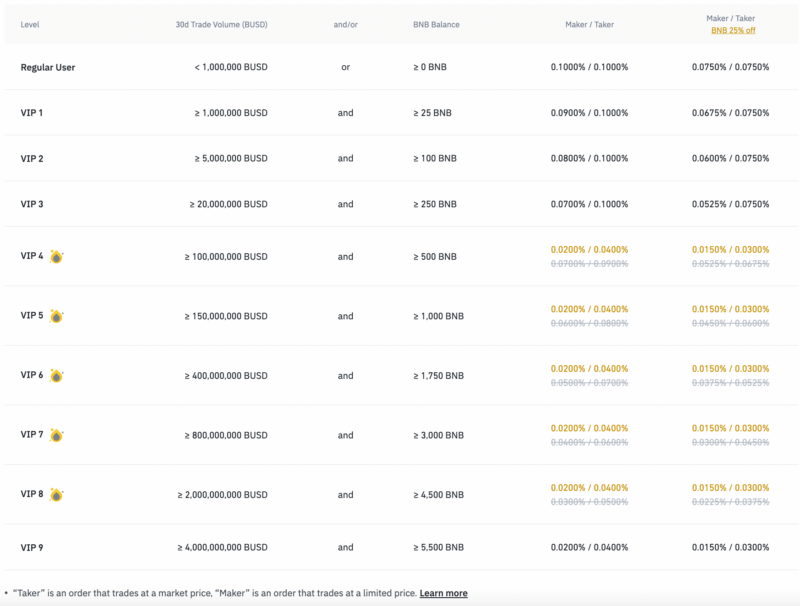
The underlying idea is simpler than the tables suggest. Binance assigns users to a category based largely on their monthly trading volume. Higher-volume customers move into higher VIP tiers and pay lower spot-trading fees. A trader in VIP 1 therefore pays more than a trader in VIP 2, while the very lowest published rates are reserved for accounts moving substantial amounts of money.
Other Ways to Get Binance Discounts
Trading volume is not the only factor that affects the final charge. Binance also distinguishes between makers and takers. A maker places an order that remains on the order book until another trader fills it. Because that order adds liquidity to the market, makers are often charged a lower fee.
A taker, by contrast, accepts an order that is already available and completes the trade immediately. That removes liquidity from the order book, so taker fees are usually higher. For ordinary users, the difference means that a carefully placed limit order may cost less than an immediate market order.
In practical terms, people who trade larger volumes and use more advanced order types can pay less than occasional users who simply buy at the current market price and move their coins to a personal wallet. Binance also provides a separate discount when trading fees are paid with BNB, the exchange’s own token. Depending on the applicable promotion and account settings, that discount has reached as much as 25%.
User Experience
Binance is reasonably easy to use, although the interface has a learning curve. Some controls appear in places that are not immediately obvious, and the platform’s tutorial pop-ups can arrive at unexpected moments. Once the layout becomes familiar, however, the amount of information on each screen is useful rather than overwhelming.
Signing Up for a Binance Account
Creating an account is straightforward, but the verification process involves several know-your-customer requirements. Users must provide basic personal details, verify contact information and submit government-issued identification. The process may also require a live photo or facial check to confirm that the applicant matches the ID.
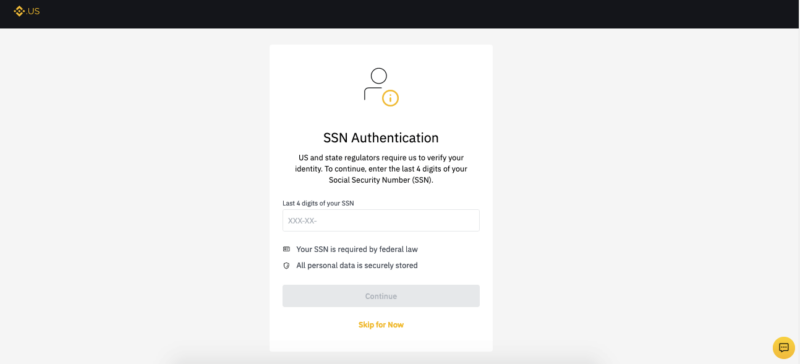
After the required steps are complete, Binance may state that identity review will take up to two days. In the original testing, approval arrived in roughly 20 minutes. That will not be the same for every customer, but the experience described in the source article was smooth and considerably faster than the maximum estimate.
Crypto Trading on Binance
Once the account is active, buying and trading cryptocurrency is fairly simple. New screens often display small explanatory messages describing the available controls and what each part of the page does. Those prompts are helpful when learning the platform, although their timing can feel inconsistent and occasionally interrupts the task at hand.
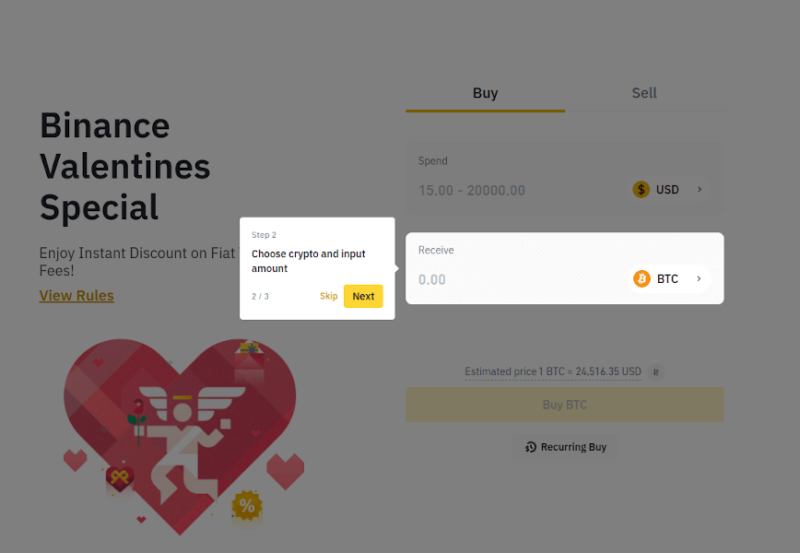
Funding an account is also relatively convenient. Binance supports a broad range of payment methods, including common credit and debit cards and, in some markets, services such as PayPal. A user can buy Bitcoin or another asset directly with fiat currency. Alternatively, the user may buy BNB first and then use it for subsequent trades to qualify for the available BNB fee discount.
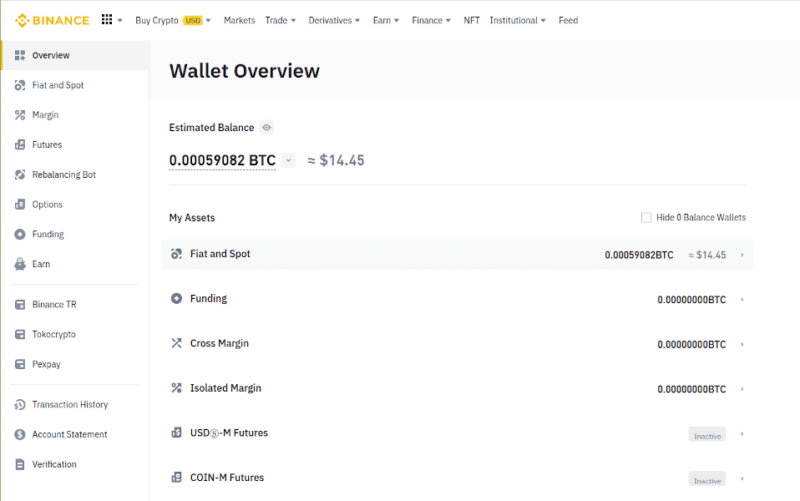
One of Binance’s strongest interface features is the amount of account information visible at a glance. Balances, holdings and trading activity are generally easy to find. That said, an exchange wallet is still controlled by the exchange. For long-term storage, a separate personal cryptocurrency wallet is usually the safer choice because it reduces dependence on the platform’s custody and continued operation.
Withdraw Money From Binance
Selling cryptocurrency and returning money to a bank account was the weakest part of the experience described in the source review. At that time, Binance had suspended bank transfers because of regulatory problems. Since bank transfers were the normal route for turning crypto back into cash on the platform, the suspension pushed users toward Binance’s peer-to-peer marketplace.
The P2P marketplace connects third-party buyers and sellers directly. Binance provides the venue and some transaction tools, but it does not accept full responsibility for every trade. Users therefore need to examine counterparties, payment conditions and signs of fraud themselves. For someone who simply wants to sell cryptocurrency and withdraw the proceeds, that process is far more complicated than a direct bank transfer.
The original article described selling through Binance as a minefield and found no clear indication of when direct sales would return. Because withdrawal methods can change by country and over time, prospective users should check the current options available in their region before depositing funds.
Final Thoughts
Binance combines a large asset selection, a deep range of products and a generally usable interface. Its fees sit around the middle of the market rather than at the absolute low end, but the company deserves credit for publishing the structure clearly enough that customers can work out what they will pay.
The disadvantages are harder to dismiss. Binance has a long record of regulatory disputes, and the process of converting crypto back into cash has at times been unnecessarily difficult. The platform may still be useful for active traders who need its liquidity and specialized products, but it is wise to approach it carefully. Avoid storing money on the exchange longer than necessary, and keep long-term holdings in a wallet you control.
The final verdict is therefore mixed rather than negative. Binance is capable, feature-rich and easier to use than many large exchanges, but its convenience does not remove the usual cryptocurrency risks or the company-specific concerns raised by its history.
Frequently Asked Questions
Can people in the United States use Binance?
The main international Binance website is not available to U.S. customers. American users are directed to Binance.US, which has historically been available in most, but not all, states. Availability and supported services should be checked against the user’s current state and local rules.
Is Binance safe?
Binance offers many of the security measures expected from a large centralized exchange, but it still carries the inherent risks of cryptocurrency trading and exchange custody. Market losses, account compromise, platform restrictions and regulatory action are all possible. Keeping long-term assets in a personal wallet reduces some custody risk.
Where is Binance based?
Binance was founded in China and left the country in 2017 after the government prohibited cryptocurrency trading. The company has since operated across several jurisdictions, and reports cited in the source article placed its headquarters in the Cayman Islands.
Is Binance better than Coinbase?
That depends on what matters most to the user. Binance publishes a more detailed and often more transparent fee schedule, while Coinbase is generally known for a cleaner, more beginner-friendly interface. Product availability and local regulations may decide the question before either of those differences does.
What is the biggest drawback of Binance?
The most practical drawback described in the original review was the difficulty of cashing out when bank transfers were unavailable. Users had to rely on peer-to-peer transactions with third parties, which required more work and exposed them to additional scam risk. Binance’s regulatory history is the broader long-term concern.